Silence vows in Zen practice
Motherless BrooklynSilence vows in Zen practice become a point of tension between Gerard Minna’s disciplined quiet and Lionel Essrog’s urgent, involuntary speech. During a candlelit confrontation after Frank Minna’s death, Lionel calls attention to Gerard’s broken silence, then tells a joke about nuns whose lifetime vow permits each of them to speak once a year. The exchange makes silence at once a spiritual discipline, a comic subject, and an obstacle Lionel tries to breach in order to reach the man behind Gerard’s serenity.
The Vow and the Confrontation
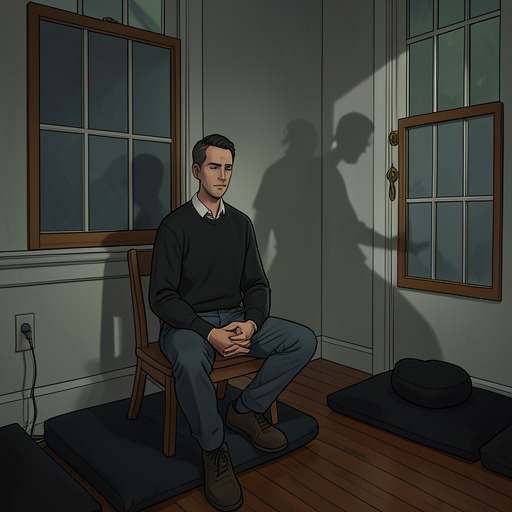
Lionel enters the room after asking to close the door. The two men face one another in the candlelit gloom, each recalling the man killed the day before: Frank. Lionel immediately points out, “You broke your vow of silence just now.” Gerard answers, “I’m finished with my sesshin,” adding that Lionel had already brought silence to a conclusive finish during that day’s sitting. His response places the vow within a defined period of practice, while also making Lionel’s earlier interruption part of the dispute between them.
Lionel accuses Gerard’s hired killer of having caused that breach, but Gerard tells him that he is speaking without thinking and recalls his difficulties in that area. Their disagreement is therefore about more than whether words have been spoken. Gerard treats Lionel’s speech as impulsive; Lionel wants speech to force a response from a man who has become difficult to read. The vow gives their encounter a boundary that Lionel has already crossed, and Gerard’s calm acknowledgment of its ending does not dissolve the tension.
A Joke About Disciplined Silence
Rather than continue the accusation directly, Lionel reaches for a joke he associates with Frank. He introduces an order of nuns, then corrects and mangles his own wording before explaining that they have taken a lifetime vow of silence. One day each year, one nun is allowed to speak. The first uses her turn to complain that the soup is terrible; a year later, another says she does not think it is so bad. The joke turns the vow into a structure that regulates not only whether anyone speaks but when speech becomes permissible.
Gerard follows the story closely. He calls the nuns disciplined and imagines the states of contemplation they might achieve over the intervening year. When the third nun finally gets her turn and calls the others’ disagreement bickering, Gerard recognizes the punch line. The exchange briefly gives the two men a shared subject and a measure of mutual understanding, but it does not reconcile them. Lionel is crying as he tells the story and wishes Frank were alive to rescue him or say that he has heard it before. The absent Frank remains an unspoken presence inside a joke about people who must wait years to speak.
Speech as Interruption and Tactic
For Lionel, telling the joke is an attempt to get behind Gerard’s composed exterior. He wants to expose the “Lord of Court Street” beneath Gerard’s Zen front and make him, in Lionel’s words, Frank’s older brother again. The story is not simply an illustration of a religious practice: its long delay, repeated silence, and eventual complaint let Lionel approach a painful subject indirectly. Gerard’s measured attention gives the joke room to unfold, but his recognition of its punch line is not evidence that he accepts Lionel’s accusation.
The scene also contrasts the vow with other forms of speech that carry information or direct action. Earlier, Lionel listens over a wire as an unseen voice addresses Frank, and later hears a voice challenge whether Frank truly listens to himself. While accompanying Frank, he hears Frank whisper through a microphone that Lionel should follow the car and play it cool. These exchanges depend on mediated listening and carefully timed words, unlike the vow’s restraint. Elsewhere, Lionel answers a service call with the practiced phrase “L and L.” The novel thus places silence beside overheard conversation, covert instruction, and routine speech, each shaped by its circumstances and audience.
From the Punch Line to the Investigation
After Gerard identifies the punch line, Lionel moves abruptly from the nuns’ silence to a direct claim: “I know about the building,” he says, naming the Fujisaki Corporation as well. The shift shows the practical limit of the joke. It has opened a brief conversational interval, but Lionel’s purpose is not to remain within it; he uses the moment to confront Gerard with what he knows. The vow’s end allows Gerard to speak, while Lionel’s own speech presses the encounter toward disclosure.
Silence in this episode is neither empty nor absolute. Gerard has completed his sesshin, Lionel has already interrupted the sitting, and the story of the nuns imagines a lifetime of restraint punctuated by sharply consequential remarks. Against that pattern, Lionel’s restless speech becomes an instrument for testing Gerard’s composure and advancing his inquiry into Frank’s death. The vow gives the scene its form: speech is withheld, delayed, joked about, and finally turned toward the facts Lionel wants Gerard to face.